




Showing posts with label Sensory Activities. Show all posts

Saturday, November 24, 2012

Getting a diagnosis of Sensory Processing Disorder

This is part 3 in a series I'm writing about our journey with Sensory Processing Disorder. You can read Part 1 and Part 2, here.

***This post was actually written last January. I've had it in draft and am just now getting around to posting it!***

As I discussed in my last post in this series, we've had issues navigating the bumpy road to an SPD diagnosis for Taylor. The primary reason is that Sensory Processing Disorder is not currently a recognized diagnosis, so health insurance companies will not cover occupational therapy (OT) for sensory issues. In many cases, SPD is accompanied by other diagnoses or delays such as autism or delay in motor skills or other developmental delays. In Taylor's case, she has met every milestone on target or early, she excels in every area at school, she is exceptionally well coordinated (in most areas) and very athletic. She is socially appropriate (in other words, she's not disruptive in her classroom, able to make eye contact, communicates appropriately and even advanced for her age) and displays a sense of humor and problem solving skills and social skills that are beyond her years.

So, while we're certainly thankful for all of these strengths, the result is that for her, SPD is a stand-alone diagnosis. When I compiled a list of Taylor's behaviors, and provided the completed SPD checklist from The Out of Sync Child to our pediatrician, I asked for a referral for an OT eval and we were seen at a local PT clinic. I live in an area where geriatrics is the main focus of health care and services, due to our population. While the OT we saw validated our concerns and agrees Taylor had many behaviors consistent with SPD, she recognized her own limitations in knowledge about SPD and referred us to another clinic for on-going OT. The referral for on-going OT was denied by our health insurance, going back to the reason that SPD is not recognized in the DSM.

I also think it's worth noting here, that the OT that completed the initial eval started going down the road of ADHD. SPD is often misdiagnosed as ADHD. Yes, Taylor is hyperactive (although I *really* hate that word!), and yes, Taylor has trouble focusing, BUT...her hyperactivity is related to her *need* for sensory input. She moves constantly as an attempt to fulfill her need for sensory stimulation. And, she can focus just fine as long as she's moving or chewing on something. In fact, she has almost no problems at school. She's able to get input in ways that are not disruptive to her class, her teachers adore her, and she's above grade level in every area. Her teachers completely scoffed at the idea that it was suggested she has ADHD.

Knowing that we desperately needed more guidance in managing Taylor's behaviors, we decided to pay out of pocket for OT at the recommended clinic. The OT we saw, came highly recommended by a dear friend who has a son with autism. During our first meeting with our OT, it became very clear how experienced and knowledgeable she is. I felt hopeful and relieved, but also a little sad, because it made all of this more real and valid. Mostly, though, I was grateful we found someone who was finally going to help us.

Prior to our appointment, I wrote a detailed report of Taylor's relevant medical history (food allergies, asthma, multiple episodes of pneumonia, chronic ear infections as an infant, the fact that she was born with the cord around her neck - which is listed as one of the factors with kids with SPD). I also wrote about our biggest behavioral challenges, and what we've put in place at home.

Our OT began our session by giving us a tour of the clinic. We ended in the "imagination room" where Taylor played with trains and cars while hubby and I talked with the OT. She began by going through a sensory profile with us. This was a multiple page scale that asked questions about how Taylor responds in certain situations. By the time we reached the 4th question, we were having a vivid dialog about our challenges and our OT had realized that we've already put a lot of things in place to help Taylor cope. For example, one of the questions was related to if Taylor is able to behave appropriately while eating out. I explained she is, as long as I bring a bag full of appropriate toys to occupy her. Left to her own devices, she'll crawl under the table, talk excessively and interrupt, and not have the patience to sit at the table. And, let's not forget about the fact that she almost never actually eats the food she is served. The food either tastes "yucky", doesn't look "good", is just plain "gross", isn't the same as the same item that I make at home or that she's served at school. 

During our discussion, we were very aware that Taylor was listening to every word that was said. I'll be completely and wholeheartedly honest, here, in hopes to validate what you may be feeling reading this, if you have a child who regularly challenges you beyond what you feel you can manage. A lot of our conversation revolved around my husband feeling like a referee between Taylor and I. While John and I have a very united front in our parenting, Taylor responds much better to his direction and discipline than she does to me.   Through this very candid discussion (while attempting to be discreet so as to not offend Taylor or impact her self-esteem), it became obvious to our OT how exhausting and unpleasant it was for me to be alone with Taylor. Everything was a battle. Our OT said the words for me in a completely empathetic and validating way, that I didn't "like" my child. This brought tears to my eyes. Tears because, she was absolutely right. Tears because how awful does that sound? Tears because I remember when she was about a yr old, someone commenting on how obvious it was that I really "liked" my kid and what a great relationship we had. I cried because we had lost that. I cried because despite all of my education and experience as a social worker, I felt totally lost at how to parent my own child. I believe that God doesn't give us anymore than we can handle, but I was really feeling like God had overestimated my abilities and strength. 

During that session, our OT gave us a lot of hope. She validated my parenting style, but also pointed to its weaknesses when it comes to raising a very strong-willed child with sensory issues. There were so many light bulb moments during that hour, I can't even begin to share it all. But I want you to know, that now, just a few months later, I can say that I like my child again, and I enjoy spending time with her. I no longer dread the weekends. Yes, there are still a lot of days that are exhausting, and she still has sensory struggles, but I'm able to control my reactions to her behavior and be more empathetic and help her through these challenges. 



Tuesday, February 21, 2012

Starting Kindergarten with Sensory Processing Disorder


This is part 2 of a series I'm writing about our SPD journey. You can read part 1 here.

In June of 2011, Taylor moved from her pre-K class at the preschool she'd been attending for 3 yrs, into the preschool's kindergarten class. While this class was just across the hall from her pre-K class, in many ways, it was a whole different world. First, her 2 best friends that she'd been with for the last 3 yrs were no longer at her school. They took the summer off and then moved into another kindergarten program. In the pre-k class, the students spent a fair amount of time standing at tables while doing their "academic" work. There was a lot of time for free play and art projects. Kids were also allowed to have a doll or stuffed animal to sleep with at nap-time.

In the kindergarten classroom, students sit in chairs at desks that are in groups of 4 to do their academic work. Their work time is generally 3 hrs long, with a short recess in the middle. There are 15 students in her class (remember, she's in a private kinder program). After lunch, the students have naptime for 2hrs and then snack, then recess and then free play time.

The transition to kindergarten was challenging for a few reasons:

1) Taylor was expected to sit, confined to a chair, for longer amounts of time

2) There was less opportunity for messy art projects (gluing, painting, etc)

3) She was no longer able to sleep with her beloved Sally at naptime, because the kinder class has a "no dolls" rule.

4) She was expected to focus on academics for a longer period of time.

5) She had to adjust to a new teacher's style and a new classroom routine.

To make matters worse, the transition occurred in the Summer in the desert. Summer temps where we live regularly get well over 100* which obviously limits outdoor playtime, which limits Taylor's ability to get the vestibular and proprioceptive input that she needs. In other words, she wasn't able to run, climb and swing outside every day. The vestibular sense is related to movement. Taylor is a sensory seeker, so she needs to move much more than other kids. Proprioception is related to body awareness and input to one's muscles and joints. So, deep touch, pushing, lifting and climbing are examples of activities that give Taylor the proprioceptive input she needs.

So, when Taylor would come home at the end of the day from kindergarten, she would literally be bouncing off the walls. She would be running, climbing on furniture, doing flips off the chairs in the living room, kicking me, pushing me (oh, how happy I am that she's ditched that behavior!), pinching me, mouthing any object she could get her hands on, talking and yelling and singing excessively. It was exhausting just watching her!

Fortunately, I have an amazing friend who has a son with Autism. One evening in September, this friend came over to hang out and observed many of the behaviors that were driving me batty. We began talking about strategies to help manage Taylor's sensory issues. I read The Out of Sync Child again. I read The Out of Sync Child Has Fun, again. And, most importantly, I put things in place at home to help Taylor get the sensory input she desperately needs to help her manage her behaviors.

While I've done a LOT of research on SPD, I'm still feeling very overwhelmed and confused about how to best implement strategies and sensory activities with Taylor. Occupational therapy is the recommended treatment for SPD. Unfortunately, we've hit some roadblocks in trying to access occupational therapy for Taylor. In my next post, I'll share the challenges we're experiencing, how we're navigating this bumpy road, what we're doing in the meantime to help Taylor.


Sunday, February 19, 2012

Sensory Processing Disorder...My amazing girl has it!


I've struggled with blogging about my daughter's newly diagnosed sensory processing disorder (there's controversary in whether it's even a "diagnosis" because it's not in the DSM, but I'll discuss that another day). I've wondered if it's exploitation. I've wondered what she'll think about what I've shared when she grows older and she reads my blog. I've wondered if I would be doing more harm than good by blogging about SPD and how it affects our family. But, ultimately, helping people is who I am and what I'm all about. I'm a social worker. Not only is it what I do, it's who I am. When faced with blended family issues and divorce and depression as a teenager, I began volunteering and helping others in similar circumstances. That was what first got me hooked on social work. When Taylor was diagnosed with food allergies, I quickly joined Kids With Food Allergies to get support and before long, I regularly shared our experience as a way to help others through their journey with food allergies. So, it just seems logical to me that I would blog about SPD as a way to not only process and record what we experience, but also to help other parents and families trying to manage SPD.

So, What is SPD?

Sensory Processing Disorder (SPD, formerly known as "sensory integration dysfunction") is a condition that exists when sensory signals don't get organized into appropriate responses. Pioneering occupational therapist and neuroscientist A. Jean Ayres, PhD, likened SPD to a neurological "traffic jam" that prevents certain parts of the brain from receiving the information needed to interpret sensory information correctly. A person with SPD finds it difficult to process and act upon information received through the senses, which creates challenges in performing countless everyday tasks. Motor clumsiness, behavioral problems, anxiety, depression, school failure, and other impacts may result if the disorder is not treated effectively.

source

Looking back, I see several SPD symptoms that were present with Taylor as an infant and toddler. She had horrible sleeping patterns as an infant. I could talk for ages about how she never slept more than 20 minutes in the first 3 wks of her life. When she *did* sleep, she was either in our arms, or in her swing. She absolutely adored being carried in a sling. She lived in her sling. I think I would have gone insane if I didn't know about babywearing. She finally started sleeping for an hr to 2 hrs at a time after we watched The Happiest Baby on the Block. And we swaddled her and put her in her swing to sleep. By 3 months, Taylor was diagnosed with reflux, so we chalked all of this up to reflux. Now, I think it was a combination of SPD and reflux. She nursed for comfort and everytime she nursed, she played with my hair, often getting her fingers caught in my hair.

Once Taylor started solids, she stuffed herself with food. When she began drinking from a cup, she "chugged" her drinks. It was as though she didn't know how to drink slowly (she still does this). As a toddler, she was much more active than her playmates. When I introduced her to messy art, she could never get enough. I remember telling people that she never watched TV, even if I put on Sesame Street, she'd never be engaged enough to focus on it. Her favorite past-time was jumping on the couch. When we went to the playground, I could never push her high enough on the swing.

While developing appropriately, at age 2, she was still not sleeping through the night. She was still nursing and still using a pacifier for comfort. We often had to tell her "gentle" when playing with us, our animals and other children. These reminders to be gentle had little impact, even with us modelling appropriate touch. She could destroy a tidy and well-organized room within minutes of being in it. Remember, she got the nick-name Tornado Taylor. By this age, she had also worn a bald spot on the right side of her head from twirling her hair constantly.

Picking her up from preschool was a nightmare (still is a lot of days). She would fight and argue and throw tantrums and run from me. I used to think the teachers must have wondered if I abuse her and that's why she hated going home. She loved being at school and all the teachers adored her (still do!).

At about 2 1/2, she was able to tell me that her jeans were "bad" and they should go in "time out" because they "hurt" her. I've only been able to get her to wear denim a handful of times since then. It was also around this age that I would notice she chewed and sucked on the bottom of her shirt or the cuffs of her sleeves. When she was 3 I was concerned about her tantrums. She would get sooo incredibly upset, she'd often become physically aggressive toward me, and she'd kick walls and doors. I'd have to physically restrain her to keep her safe. I've had some training in how to do this safely, since I've worked with children who become violent.

It was also around this time that I really had to engage her in structured activities at home on the weekends in order to keep her "well behaved". I started doing more messy art activities with her. At the time I had no idea these were sensory activities. I thought we might be on the road to a diagnosis of ADHD because she was so active and continued to run circles around her peers.

When she was almost 4 I remember thinking "Are kids still teething at four because, man this kid sucks and chews on everything!". We found ourselves saying "If it's not food it doesn't go in your mouth!" several times a day.

And then...someone suggested I read Raising Your Spirited Child. WOW! That was a game changer for me. In reading that book, I found a new understanding of my daughter. I realized not only is she spirited, she also displayed a lot of sensory seeking behaviors.

In the midst of all this, we were still dealing with reflux, a new diagnosis of asthma and a few bouts of pneumonia. Taylor was also coughing while eating (and still "chugging" her drinks) which can be an indicator of swallowing issues. So, after our GI ordered several tests and procedures, we landed ourselves in an Occupational therapist's office for a feeding evaluation. I will feel forever indebted to the OT, Stacy who finally saw the same child that I saw. Stacy determined that Taylor's feeding issues were related to sensory issues.

Stacy commented on how cute and playful and smart Taylor is (she is all of those things!). But, within minutes, Stacy had turned the discussion from feeding issues to the behaviors she was seeing Taylor display in her office. Taylor was crawling on the floor on her hands and knees and spinning herself. She was bouncing on the therapy ball and climbing to reach a bin full of dried beans. Stacy started asking if I was seeing any sensory seeking behaviors at home. I immediately felt relieved and validated. I left with a greater understanding of my daughter, a list of heavy work activities, and a recommendation to read The Out of Sync Child.

Taylor's "sensory issues" had been confirmed. But, as I wrote about in this post, I wasn't considering a diagnosis of Sensory Processing Disorder at that point. It wasn't until she entered kindergarten that I became more concerned about her sensory issues.

Stay tuned for part 2 of our SPD journey later this week.


Wednesday, November 30, 2011

Daily Routine Chart and Behavior Chart

I mentioned in my last post that Taylor's sensory issues have become much more prominent in the last 6 months or so. I'll be blogging more about Sensory Processing Disorder as I have time, but for now I want to share a tool I developed for us to have more structure and less meltdowns in our day.

Taylor is a child who thrives on control. I know all children benefit from structure, but for Taylor, when her routine is out of whack and she doesn't know what to expect next, it sets her up for anxiety, uncertainty and horrible behavior. We had an occupational therapy evaluation last week to help us diagnose and treat the Sensory Processing Disorder that we see emerging with Taylor. One of the suggestions the OT had, was to have more structure in our days. The caveat, of course, being that all kids need time for freedom and free play.

I've been wanting to create a routine chart and a behavioral/reward system for Taylor for quite some time, to give her an added sense of control over her day. So, after looking at various resources, I found Sparkle Box. They offer 1000's of free printables. While most of their resources as aimed at teachers and education, they also have a section for parents and homeschooling. I printed off their daily routine cards, and cut out the ones that apply to us. I then used my Xyron machine and laminated each of the cards.

I included a heading that identifies the day of the week, under that I added what time of day/routine we were working on: Morning, Afterschool, Bedtime. Finally, I went through our routine and the basics of what needed to be done at each time of day and wrote it out on paper to help me organize the cards. This also made me realize that I need to make or find other cards for activities that weren't included in the set I printed. For example, I'm working on having Taylor take more responsibility for household chores, so I need cards that say "set the table" and "fold laundry" and "clean up toys". I also need to create some custom cards that include photos of her medications (asthma and allergy) and some of her sensory activities. You can see from the photo above that we don't have a picture to show the task of getting dressed. We'll be adding that!

Once I had the cards organized, I added velcro dots to the chart and the cards. I was able to determine that at this point, each of our routines has at most, 6 steps, so their are 6 velcro stickers that stay on the board and the cards are attached and removed as the routine is completed.

Other ways she can earn star stickers is by following her rules, and then there is opportunity for us to give her stickers for random good behavior. This makes us more aware of catching her being good. After a week of accumulating lots of stars, on Fridays she will get to choose one thing that she wants: either McDonald's, Wendy's, Dairy Queen or Starbucks. Now, I'm really not fond of offering food as rewards, but when Taylor outgrew her food allergies, we got in the bad habit of often grabbing fast food on the way home from school. This soon turned into her expecting fast food everyday. When I refused her requests, a major tantrum would ensue. So, the new rule is she can have fast food once a week, only on Fridays and this eliminates the daily battle.

I also added a calendar to the chart so we can see upcoming events and talk about them, count down the days until they happen, etc. Finally, I added a place for reminders and important notes/papers. Our fridge is not magnetic and so we can't use it as our central command center. This bulletin board is a great place to keep track of all the little things that I need to see or they get forgotten.

I'm sure I'll end up making changes to the board as we figure out what works for us. But, so far, Taylor loves the board and she's responding really well to the structure and knowing what's going to happen next.


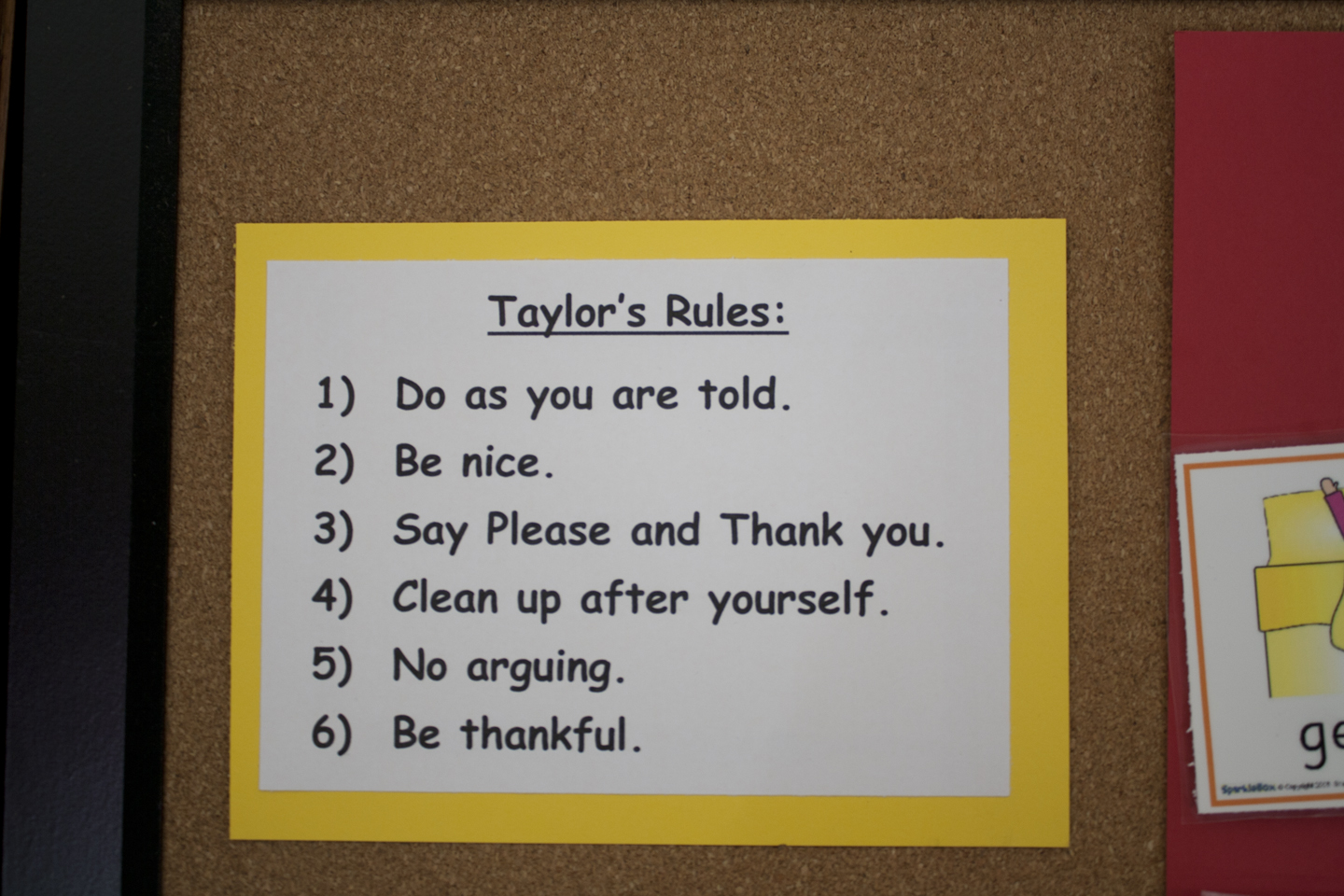
A few weeks ago, during a very trying time of behavior problems, I wrote out a set of rules for Taylor. I decided to include the rules on her routine board and under the rules, I added a star behavior chart that I printed from Sparkle Box. I then purchased star stickers at the dollar store. There are 10 spaces for stars on the chart each day. At this point, Taylor gets one star for following each of her routines without a big fight. I give a little bit of leeway with "not a big fight" because I recognize that I have a very, very strong-willed child. I also like that she's assertive and I recognize that one of the rules she struggles with the most, is rule #1 Do as you are told. She's just not that compliant of a child (at least not at home!). That's not her personality. She often needs to do things "her way". So, as long as she follows her routines without a "big" fight, then we're happy and she gets a sticker.

Our system has quickly become an activity in itself. Taylor likes going to the board to see what's up next, she takes the cards down once she's completed the task, and she's responding really well to the star sticker system.

Do you have a system like this for your child? I'd love to hear how you manage routines and behavior in your home.


Sunday, October 11, 2009

Painting with Veggies!

I cleaned out the fridge earlier this week and when I gathered these veggies that were well beyond their prime, I remembered a Toddler Art Party that my mom's group did when our kids were around 18 mos old. The host of the party set up a free painting area and had all kinds of veggies for the kids to paint with. I decided to do this again with Taylor. She loved it!

Basically, I just covered 2 cookie sheets with foil, laid out the cut fruits and veggies on one of the cookie sheets and put puddles of paint on the other cookie sheet. As always, we used our muffin tin to mix our paint colors. Then Taylor chose her fruits/veggies and dipped them in the puddle of paint, then stamped then onto the paper. By the end of her art session she was using the veggies as "brushes" and dragging them in various ways on her paper.

Thursday, July 9, 2009

Sensory Activities

I came across this great post on sensory activities at Roots and Wings Co. via The Crafty Crow. I'll definitely be doing these activities with Taylor!

Thursday, July 2, 2009

Shaving Cream Fun

Another sensory activity...basically I just set up the stuff and let Taylor have at it! I'll let the photos speak for themselves...any questions, let me know!

Saturday, June 20, 2009

Learning to sew

This project was inspired by Mary Ann Kohl and Amanda Soule. I want to get Taylor more involved in sewing and she likes to "play" with my sewing supplies. So, we tried this simple art project the other day...

Start with the materials in the photo above: paint, paintbrush, cardboard shapes, and a piece of burlap. You'll also need an embroidery needle and yarn or embroidery thread. They make plastic needles that are perfect for little sewers! I got mine at JoAnn's.

Paint the shapes. Take a break while they dry :)

Once they're painted and dried, use a hole punch and punch 2 or 4 holes in the center of the shapes to make cardboard "buttons"

Guide your little one and start sewing by bringing the needle through the back of the fabric and through the hole in the shape.

Be very proud of how quickly your little one catches on!

Taylor was content to sew just one button, but I've got a mindful of ideas now for simple handsewing projects we can do together. This is just the beginning!

Thursday, June 4, 2009

Sensory Activities

I have recently discovered that I have a sensory seeking child. I mean, I've always known that she loves to cuddle, run, spin, jump and dance (constantly). I've always known she's waaaaay more energetic than most kids her age. I've always known that if I put her in water when she's cranky, she transforms into a different person (just like her mama!). I've always known that she will dive right into any messy activity I set up for her. I noticed very early on that as soon as we open a book she has to climb into my lap and be held as I read to her and she has to touch the pictures and turn the pages. I've always known that when we go shopping she wants to touch everything. When we're at home, she loves rough-housing with Daddy and always wants him to toss her in the air. She often pulling at my shirt just for fun and wants to sit in my la as soon as I sit down. She loves bear hugs! Yes, I've always known these things about her personality. What I didn't know, was that all of this combined means that she is a sensory seeker.

What does this all mean? Why am I excited about this discovery? Because....I have realized that when my sweet, adorable, fun-loving 3 year-old becomes an argumentative, aggressive, bratty child who is depleting all my energy, if I engage her in a sensory activity then a calm comes over her, the balance in the universe is restored, birds sing beautiful tunes in my head and I can once again, hear myself think. So...as I gather supplies and introduce her to more sensory activities, I'll be posting them, so if you have a child who is also a sensory seeker you can add these activities to your toolbox and regain your child's sense of inner peace and maintain your sanity! Sensory activities are also good for children who are not sensory seekers, but rather the opposite, and aversions to sensory stimulation. Every day we are exposed to different textures, sounds, sights, and smells. Exposing young children to different sensory experiences can make them more comfortable when faced with different sensory stimulation out in the world.


This realization was sparked by the book Raising Your Spirited Child, but it became clear what a sensory seeker, Taylor is when I read this checklist and read the section on sensory seeking behavior and hyposensitivity to movement. Don't get me wrong, I'm not labeling my child with Sensory Integration Disorder. Her sensory seeking behavior doesn't impair her learning or her daily functioning. This is simply useful for me to see her behavior in this light because it helps me curb her tantrums, give her opportunities to regain her composure and comfort herself.

Taylor loves the sandbox but summer temps can get into the triple digits where we live, so sitting out in the heat watching her play in the sand isn't always ideal. So, the other day I poured some almost empty bags of rice and alphabet pasta into a plastic shoebox. Then I buried some "treasures" for her to find. I buried a pom-pom, a jumbo paperclip, a few large buttons, a safety pin, a crayon, a scrap of ribbon, a plastic ring and an eraser. I then gave her some tongs to use to dig for the treasures and picked them up with.

The next day, I pulled it out and gave her some kitchen utensils to play with. I set up the rice on the floor with a kitchen mat underneath, because it seemed too awkward for her to play at her table and dig into the bucket. Daddy was not too excited about her need to scoop the rice out of the bucket on to the mat. I think that's part of the fun and exploration. We came to a compromise and he used a binder clip to clip 2 tubs together so she could move the rice from one tub to the other. Brilliant!

As you can see, she was enthralled in the activity! I'm keeping the rice tub ready to go in her craft cabinet for easy access.

Do you have a child who is a sensory seeker? One with sensory aversions? What sensory activites do you do with your kids? I'd love to hear them!